
EDI 944 Definition
The EDI 944 transaction set is an electronic Warehouse Stock Transfer Receipt Advice that is used by third-party logistics providers or warehouses to inform a depositor or an agent of the depositor that the transferred shipment has been received. This transaction set also provides detailed information about the product that has been received. The depositor will respond to the warehouse Stock Transfer Receipt Advice with an EDI 997 Functional Acknowledgment to confirm that the EDI transaction has been received.
Sent By: Warehouse or Third-Party Logistics Provider (3PL)
The warehouse sends EDI 944 after receiving and verifying an inbound stock transfer shipment. This confirms to the depositor that goods have arrived at the warehouse and provides details on what was received, including quantities, item numbers, and condition.
Received By: Depositor, Supplier, Manufacturer, or Distributor
The depositor receives EDI 944 to confirm that their inventory has arrived at the warehouse. This allows the depositor to update inventory records, reconcile against what was shipped, and identify any discrepancies such as shortages or damages.
What EDI 944 Represents in Real Life
EDI 944 is not just a receipt confirmation. It is the inventory handoff that happens the moment when goods officially transition from in-transit to warehouse stock. Without it, suppliers and manufacturers have no automated visibility into whether their product actually arrived.
When an EDI 944 is processed successfully:
- The supplier or manufacturer knows exactly what arrived at the warehouse
- Inventory records are updated to reflect received quantities
- Discrepancies between shipped and received quantities are flagged immediately
- The supplier or manufacturer can plan fulfillment and replenishment with confidence
In short, the EDI 944 closes the loop on inbound logistics and puts inventory on the books.
EDI 944 Specification
This X12 Transaction Set contains the format and establishes the data contents of the Warehouse Stock Transfer Receipt Advice Transaction Set (944) for use within the context of an Electronic Data Interchange (EDI) environment. The transaction set can be used to provide for customary and established business and industry practice relative to advising a depositor that a stock transfer shipment has been received at the warehouse.
Source: Accredited Standards Committee X12. ASC X12 Standard [Table Data]. Data Interchange Standards Association, Inc., Falls Church, VA. https://x12.org
Components of an EDI 944 Warehouse Stock Transfer Receipt Advice
Each EDI 944 Warehouse Stock Transfer Receipt Advice document contains segments and data elements. Each segment contains at least one data element. Each data element is a data field. Examples of data elements are:
- Supplier information
- Shipment identification info
- Date of the shipment
- Item numbers, descriptions, quantities and units
- Receiving warehouse location
- Shipper information
Additional data that may be included in the receipt advice pertains to:
- Serial numbers and lot numbers
- Case weights
- Damage or shortage details
- Reference and tracking numbers
- Warehouse receipt number
Related EDI Transactions
- EDI 810 – Invoice
- EDI 812 – Credit / Debit Adjustment
- EDI 820 – Payment or Order Remittance
- EDI 830 – Planning Schedule with Release Capability
- EDI 832 – Price/Sales Catalog
- EDI 846 – Inventory Inquiry
- EDI 850 – Purchase Order
- EDI 855 – Purchase Order Acknowledgment
- EDI 856 – Advance Ship Notice
- EDI 860 – Order Change Request
- EDI 867 – Product Transfer and Resale Report File Format
- EDI 875 – Grocery Products Purchase Order
- EDI 990 – Response to a Load Tender
- EDI 997 – Functional Acknowledgement
- EDI 204 – Motor Carrier Load Tender
- EDI 210 – Motor Carrier Freight Details and Invoice
- EDI 214 – Transportation Carrier Shipment Status Message
EDI 944 Sample File Format (Raw EDI File)
ISA*00* *00* *12*111111111 *12*222222222 *230520*1324*U*00401*000000020*0*P*>~GS*RE*111111111*222222222*20230520*1324*20*X*004010~ST*944*0001~W17*F*20230511*28296*TEST2*TEST2~N1*WH*Cold Storage~W07*10*EA**VN*123456789*UP*123456789012*072220~N9*SN*400003928227~N9*SN*400003928164~N9*SN*400003928124~N9*SN*400003928015~N9*SN*400003928179~N9*SN*400003928007~N9*SN*400003928121~N9*SN*400003928365~N9*SN*400003928129~N9*SN*400003928324~N9*CW*73.2~N9*CW*74.0~N9*CW*67.4~N9*CW*67.8~N9*CW*72.4~N9*CW*70.4~N9*CW*68.6~N9*CW*81.0~N9*CW*72.2~N9*CW*76.4~W14*10~SE*26*0001~GE*1*20~IEA*1*000000020~
What Each Line in the EDI 944 Sample Means
Each segment in an EDI 944 serves a specific purpose. Here is a breakdown of the sample file above:
ISA – Interchange Control Header. Opens the EDI envelope. Contains the sender ID (111111111), receiver ID (222222222), date (230520), time (1324), control number (000000020), and standards version (00401).
GS – Functional Group Header. Identifies the type of transaction (RE = Warehouse Stock Transfer Receipt Advice) and groups one or more 944 transactions together.
ST – Transaction Set Header. Marks the beginning of the 944 transaction. The “944” identifies the document type and “0001” is the unique transaction set control number.
W17 – Warehouse Receipt Identification. Contains the receipt status (F = Full receipt), receipt date (20230511), shipment number (28296), and depositor order numbers (TEST2).
N1*WH – Warehouse Name. Identifies the receiving warehouse (WH = Warehouse). In this case, “Cold Storage” is the facility that received the goods.
W07 – Item Detail for Stock Receipt. Contains the quantity received (10), unit of measure (EA = Each), vendor part number (123456789), UPC code (123456789012), and product date (072220).
N9*SN – Serial Number Reference. SN = Serial Number. Each N9*SN line identifies an individual serial number for the items received (e.g., 400003928227). In this sample, 10 serial numbers correspond to the 10 units received.
N9*CW – Case Weight Reference. CW = Case Weight. Each N9*CW line provides the weight of an individual case (e.g., 73.2 lbs). The 10 weights correspond to the 10 units received.
W14 – Total Receipt Information. Summary of the receipt: 10 total units received.
SE – Transaction Set Trailer. Closes the 944 transaction. Contains the segment count (26 segments) and the matching control number from the ST segment.
GE – Functional Group Trailer. Closes the functional group. Indicates 1 transaction set was included in this group.
IEA – Interchange Control Trailer. Closes the entire EDI envelope. Confirms 1 functional group and the matching interchange control number from the ISA segment.
What an EDI 944 Looks Like Inside Elevate
Although the raw EDI 944 is machine-readable, our cloud-based EDI platform Elevate presents the receipt advice in a clean, readable format for business users.
Inside Elevate, teams can see:
- Receipt date and shipment identification
- Warehouse location and name
- Item details, quantities received, and UPC codes
- Serial numbers and case weights
- Discrepancies between expected and received quantities
- Status of processing and acknowledgment
This visibility helps warehouse managers, inventory teams, and operations troubleshoot receiving issues quickly without reading raw EDI.
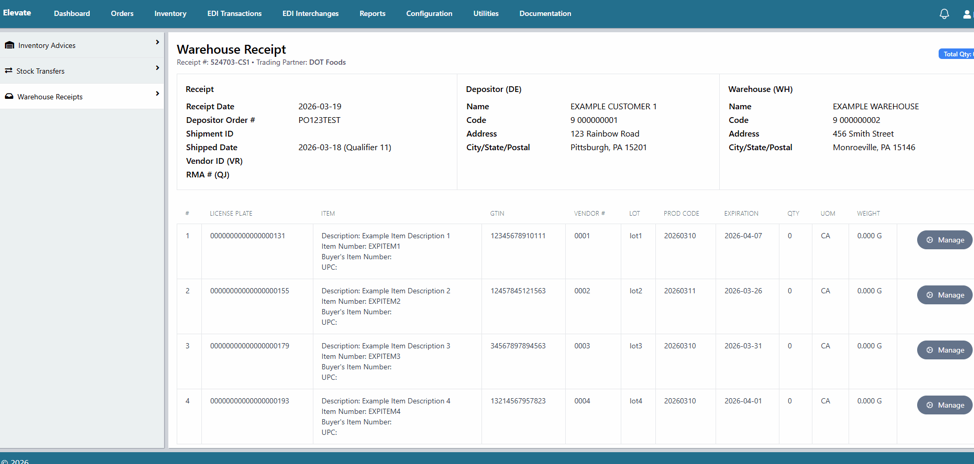
EDI 944 Warehouse Stock Transfer Receipt Advice in Elevate
How to Start Receiving EDI 944 Warehouse Stock Transfer Receipt Advice
If your business uses a third-party warehouse or 3PL to store inventory, here is a general roadmap for receiving EDI 944 documents:
- Confirm your warehouse supports EDI 944: Not all warehouses or 3PLs send EDI documents by default. Confirm that your warehouse can generate and send 944s electronically, and ask for their EDI implementation guide.
- Choose an EDI platform: You need EDI software to receive, translate, and process the incoming 944 into a format your team or ERP system can use. Cloud-based platforms like Elevate make this straightforward with transparent pricing, no contracts, and end-to-end support.
- Map the data to your system: Connect the incoming 944 segments to the corresponding fields in your ERP or inventory management system. This includes received quantities, item numbers, serial numbers, case weights, and warehouse location details.
- Test with your warehouse: Before going live, have your warehouse send test 944 transactions so you can validate that the data maps correctly and your system processes it as expected. Most trading partners require a testing phase before production.
- Go live and monitor: Once testing is complete, begin receiving production 944s. Monitor for errors, missing acknowledgments, and discrepancies between what was shipped (943) and what was received (944). A good EDI platform will alert you to issues in real time.
Need help with EDI 944 implementation and more?
Elevate is built for small businesses and includes hands-on onboarding so you don’t have to figure it out alone.
Real-World Example: Warehouse Receiving a Stock Transfer
A manufacturer transfers 200 cases of product from one facility to a third-party cold storage warehouse.
- The manufacturer sends an EDI 943 Warehouse Stock Transfer Shipment Advice to the warehouse
- The shipment arrives at the cold storage facility
- The warehouse receives, inspects, and counts the product
- The warehouse sends an EDI 944 back to the manufacturer with actual received quantities, serial numbers, and case weights
- Elevate validates the receipt data and flags any discrepancies against the original 943
- The manufacturer updates inventory records automatically
- If quantities match, no manual intervention is needed
When the 944 is accurate, inventory transitions seamlessly from in-transit to available stock.
Why EDI 944 Accuracy is Critical
Receipt errors create inventory problems that compound over time.
Common problems include:
- Quantity mismatches between what was shipped and what was received
- Missing or incorrect serial numbers
- Wrong warehouse location codes
- Inaccurate case weights affecting logistics planning
These issues lead to:
- Phantom inventory — stock that exists on paper but not in the warehouse
- Fulfillment failures when orders are allocated against incorrect counts
- Manual cycle counts and reconciliation work
- Disputes between depositors and 3PLs
- Delayed or inaccurate invoicing
A clean EDI 944 keeps inventory accurate from the moment goods arrive.
Common Challenges with EDI 944 Warehouse Stock Transfer Receipt Advice
- Different depositors require different 944 formats and field mappings
- Partial receipts require multiple 944s tied to a single shipment
- Cold chain and perishable goods require additional data like temperature and lot codes
- Serial number tracking adds complexity when volumes are high
- WMS or ERP migrations can break existing 944 mappings
Flexible EDI systems handle these scenarios without breaking the flow.
FAQs
1. What is the difference between an EDI 944 and EDI 943?
EDI 943 is a Warehouse Stock Transfer Shipment Advice sent from the depositor to the warehouse, notifying the warehouse that a shipment is on its way. EDI 944 is the warehouse’s response, confirming that the shipment was received. Think of 943 as the heads-up and the 944 as the confirmation.
2. What is the difference between an EDI 944 and EDI 945?
EDI 944 confirms that goods were received at the warehouse (inbound). EDI 945 confirms that goods were shipped out of the warehouse (outbound). EDI 944 is about receiving; 945 is about shipping.
3. Who sends EDI 944?
The warehouse or third-party logistics provider (3PL) sends EDI 944 to the depositor, supplier, manufacturer, or distributor after a stock transfer shipment has been received and verified.
4. Is EDI 944 required?
It depends on the trading partner relationship. If a supplier or manufacturer uses a third-party warehouse or 3PL for stock transfers, 944 is typically a required part of the EDI workflow. Without it, the supplier or manufacturer has no automated way to confirm that goods arrived.
5. What happens after EDI 944 is received?
The supplier or manufacturer receives 944, responds with an EDI 997 Functional Acknowledgment, and updates their inventory records. If discrepancies are found between 943 and 944, the supplier or manufacturer may initiate an investigation or adjustment with the warehouse.
6. Can EDI 944 include serial numbers and case weights?
Yes. The N9 segment is commonly used to include serial numbers (N9*SN) and case weights (N9*CW) for each item received. This is especially common in industries like food and beverage, pharmaceuticals, and electronics where traceability is critical.
7. What EDI version does 944 use?
EDI 944 follows the ANSI X12 standard. The most commonly used versions are 4010 and 5010, though the specific version depends on your trading partner’s requirements.