
Home > Knowledge Base > What is an EDI Payment?
What is an EDI Payment? EDI 820
How does EDI differ from EFT and ACH?
Highlights
- An electronic data interchange payment uses standardized EDI transactions like EDI 820 to send payment and remittance details electronically between trading partners.
- EDI sends structured payment information such as invoice references and payment amounts, while the actual transfer of funds typically occurs through ACH or other EFT methods.
- After documents like EDI 850 (purchase order) and EDI 810 (invoice) are exchanged, the EDI 820 payment order/remittance advice helps finalize the transaction and reconcile payments automatically.
What is an EDI Payment? (EDI 820 Explained)
EDI (Electronic Data Interchange) is the process of business to business exchange of documents in a standard format electronically. This makes it extremely useful for the EDI payments (along with exchanging other documents) because it provides a secure mode of payment transfer from computer to computer.
EDI payments complete an EDI order cycle by having the supplier paid by the buyer who bought their product. Let’s consider an example under ANSI X12 standards An EDI 820 is a payment order or remittance advice document which is sent in response to EDI 810 (Invoice). Generally, it is used to communicate initiation of a payment by a buyer to a seller. This streamlines and fastens the payment process like the overall order cycle because both parties have visibility and transparency into payment details. Businesses are seen to improve their cash flow with an efficient process like EDI.
What is an EDI 820?
The EDI 820 transaction set under the ANSI X12 standard is used to communicate payment and remittance information from a buyer to a supplier.
It typically serves two purposes:
-
- Payment Order – informs the supplier that a payment has been initiated
- Remittance Advice – provides detailed information about which invoices are being paid
The EDI 820 is commonly sent after a supplier submits an EDI 810 Invoice.
Instead of emailing spreadsheets or sending remittance advice separately, the buyer sends structured payment information electronically so the supplier can automatically reconcile the payment against open invoices.
What Information Does an EDI 820 Contain?
An EDI 820 includes the financial and reference data needed to reconcile payments with invoices.
Common elements include:
Replace the content that was here with this new content
1. Payment Information
- Total payment amount
- Payment method (ACH, check, wire, etc.)
- Payment date
- Currency
2. Payer and Payee Details
- Buyer name and address
- Supplier name and address
- Bank account information
- Routing details
3. Invoice References
- Invoice numbers
- Invoice dates
- Payment amounts per invoice
- Adjustments, discounts, or deductions
4. Financial Identifiers
- Check number
- ACH trace number
- Reference numbers for accounting reconciliation
Because this data is structured, it can automatically post to accounting or ERP systems without manual intervention.
EDI 820 Transaction Structure (Key Segments Explained)
The EDI 820 payment order/remittance advice contains multiple segments that communicate payment and invoice reconciliation details in a standardized format. While the exact structure can vary depending on trading partner requirements, most EDI 820 transactions contain the following key segments.
ST – Transaction Set Header
Identifies the document as an EDI 820 payment order/remittance advice transaction.
BPR – Beginning Segment for Payment Order
Defines key payment information such as:
- Payment method (ACH, wire, check)
- Total payment amount
- Bank account details
- Payment date
This segment essentially initiates the electronic data interchange payment instruction.
TRN – Trace Number
Provides a unique reference number that allows both parties to track the payment.
N1 – Name Segment
Identifies the entities involved in the payment, including:
- Payer (buyer)
- Payee (supplier)
ENT – Entity Information
Specifies which entity the remittance advice applies to.
RMR – Remittance Advice Accounts Receivable Open Item
This segment is used to reference invoices that are being paid. It typically includes:
- Invoice number
- Invoice amount
- Amount paid
- Any adjustments or deductions
SE – Transaction Set Trailer
Marks the end of the EDI 820 transaction.
Because the information is structured and standardized, accounting systems can automatically reconcile payments with invoices
Example of an EDI 820 File
ST*820*0001~
BPR*C*15000*C*ACH*CTX*01*123456789*DA*987654321*1512345678**01*987654321*DA*123456789*20260305~
TRN*1*1234567890~
N1*PR*Buyer Company*1*123456789~
N1*PE*Supplier Company*1*987654321~
ENT*1~
RMR*IV*INV1001*5000~
RMR*IV*INV1002*7000~
RMR*IV*INV1003*3000~
SE*10*0001~
How Do EDI Payments Work?
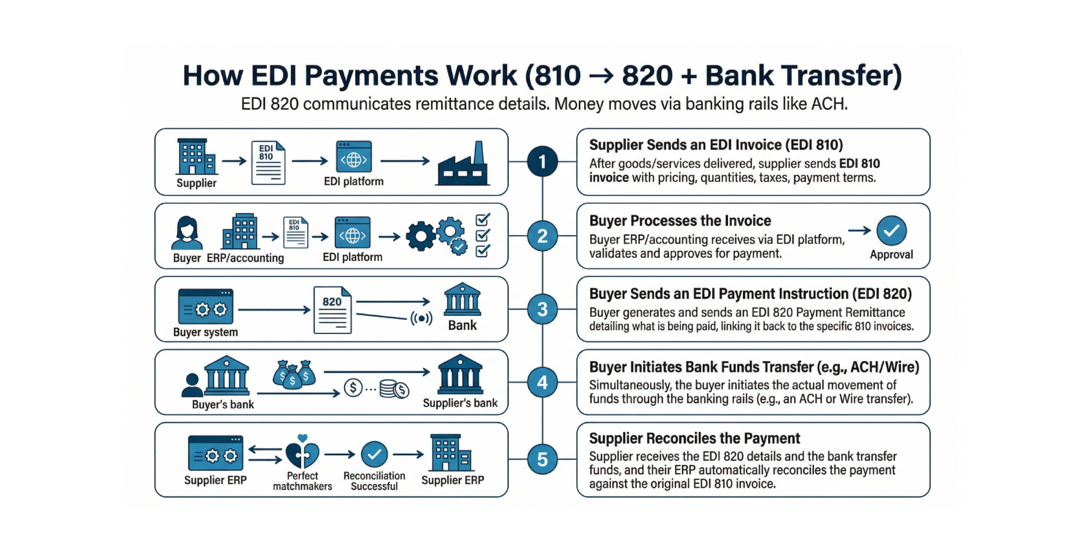
As soon as the buyer receives an invoice (EDI 810) from the seller, the buyer sends out the payment remittance information in the form of an EDI 820 to the seller to show the intent to pay. Then, the seller transmits this information to its bank for receiving the payment through EDI or any other method decided between the two entities.
The bank receives the information from the seller (through EDI or any other mode) and converts it into the format necessary for its transmission through the Automated Clearing House (ACH) as an ACH transaction. The ACH processes the payment and its associated information to the seller’s bank. Then, the bank credits the seller. The seller receives a notification that the funds are posted in the company’s bank account.
Why Businesses Use EDI Payments
Companies processing hundreds or thousands of invoices each month benefit from EDI payments because they eliminate manual reconciliation.
1. Faster Invoice Reconciliation
Accounting teams can automatically match payments to invoices without manually reviewing remittance advice.
2. Fewer Payment Disputes
Since the EDI 820 includes detailed invoice references, suppliers can easily see which invoices were paid and which were adjusted.
3. Improved Cash Flow Visibility
Suppliers receive advance notice of payments before funds arrive.
4. Reduced Administrative Work
Manual remittance processing often requires:
- Spreadsheet reconciliation
- Email communication
- Manual accounting entries
EDI payments automate this process.
How do EDI Payments Differ from Manual Payments?
Manual payments require human labor to send payment information through mail, fax, or email and you have to pay them for manual tasks like data entry into different systems. EDI payments as a part of an overall EDI order processing are automated between organizations and within internal systems to speed up operations, eliminate any extra steps and avoid errors.
| Process | Manual Payments | EDI Payments |
| Remittance Advice | Sent by email or paper | Sent electronically in EDI format |
| Invoice Matching | Manual reconciliation | Automated matching |
| Processing Time | Slow and labor intensive | Automated and fast |
| Error Risk | High (data entry errors) | Low (system-to-system exchange) |
| Payment Visibility | Limited | Real-time tracking |
What’s the Difference Between EDI, EFT, and ACH?
EDI, EFT and ACH can easily be misunderstood as they are used synonymously when talking about bank transactions. Do they mean the same?
| Term | What It Means | What It Does |
|---|---|---|
| EDI | Electronic Data Interchange | Exchanges business documents electronically |
| ACH | Automated Clearing House | Bank network that moves money between accounts |
| EFT | Electronic Funds Transfer | General term for electronic payments |
EDI is a standardized format for exchanging documents electronically only and not a type of electronic payment. In short, EDI does not technically pay you. It is a way to send and receive payment details between two parties to make the order cycle more efficient.
The ACH (Automated Clearing House) or electronic transfer of funds is a financial system used for direct payments and direct deposits (in short a system that actually pays you). This is an alternative to checks, cash, credit cards and wire transfers for transferring money from one bank to the other. ACH payments are faster than checks or credit card payments.
ACH is considered a central system that collects and batches financial transactions and processes them at intervals throughout the day. Any company or individual can originate a direct deposit or payment using the ACH network.
The common thing between ACH and EDI is that both contain remittance details.
EFT is also called electronic funds transfer that embodies all types of electronic payments including ACH. EFTs include credit card, online and mobile payments, direct deposits and wire transfers.
ACH payments out of the EFT are the most secure because they undergo a rigorous due-diligence process by having to make it through a clearing house in between. ACH can only be used when making a digital transfer of money between two banks vs EFT can happen real-time with or between banks.
Example of an EDI Payment Workflow
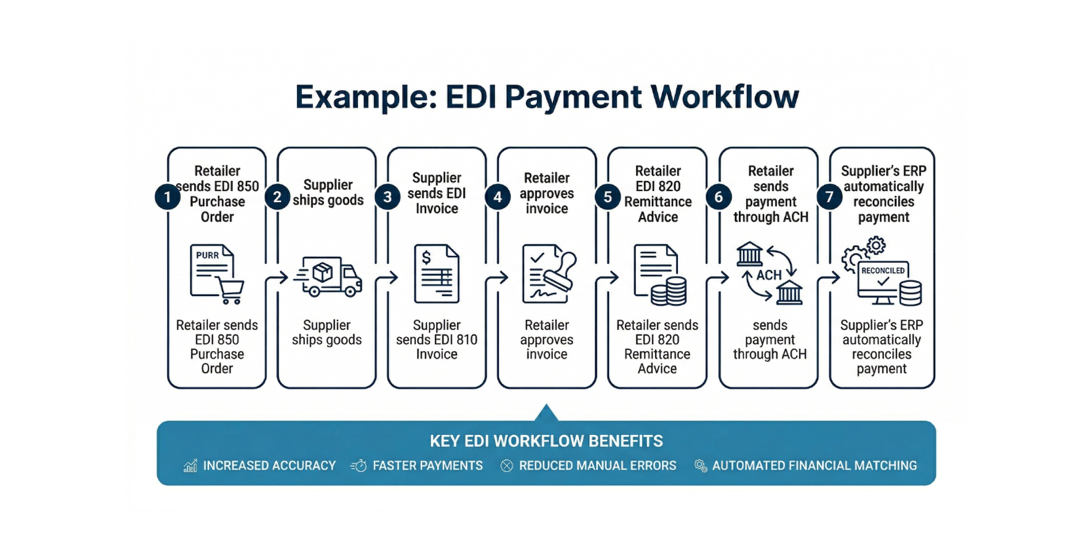
Imagine a retailer ordering products from a supplier.
- Retailer sends EDI 850 Purchase Order
- Supplier ships goods
- Supplier sends EDI 810 Invoice
- Retailer approves invoice
- Retailer sends EDI 820 Remittance Advice
- Retailer sends payment through ACH
- Supplier’s ERP automatically reconciles payment
-
Without EDI, this process typically involves spreadsheets, emails, and manual accounting work.
Best Practices for Implementing EDI Payments
Companies implementing EDI payments should consider a few key practices.
Automated posting ensures remittance advice is automatically matched with invoices.
2) Standardize Payment Workflows
Define consistent rules for:
- Payment schedules
- Discount handling
- Invoice references
3) Automate Reconciliation
Use ERP or accounting integrations to match:
- EDI invoices
- EDI 820 remittances
- Bank deposits
Even with automation, payment adjustments or deductions may occur. Exception management workflows ensure discrepancies are handled quickly.
EDI Payments for Small and Mid-Sized Businesses
Many smaller companies assume EDI payments are only used by large enterprises.
In reality, retailers, distributors, and logistics companies frequently require EDI compliance from suppliers of all sizes.
For smaller teams, the challenge is often managing EDI without dedicated internal EDI specialists.
Modern cloud-based EDI platforms can simplify this process by handling:
- EDI document translation
- Trading partner connectivity
- ERP integration
- ongoing monitoring and support
This allows businesses to exchange EDI documents and payment information without maintaining their own EDI infrastructure.
Common EDI Payment Errors (And How to Avoid Them)
Even though EDI payments automate financial processes, errors can still occur if systems or data are not configured properly.
- Invoice Mismatch
If the invoice numbers referenced in the EDI 820 remittance advice do not match the supplier’s records, reconciliation may fail.
Best practice: Ensure invoice numbering standards are consistent across systems.
- Payment Amount Discrepancies
Differences between invoice totals and payment amounts may occur due to deductions, discounts, or short payments.
Best practice: Include adjustment codes within the EDI transaction.
- Incorrect Bank Information
Errors in routing numbers or account details can delay payments.
Best practice: Validate banking details during EDI partner setup.
- Missing Remittance Details
If payment is sent through ACH but remittance details are not included, suppliers may struggle to reconcile payments.
Best practice: Always pair ACH payments with EDI 820 remittance advice.
EDI Support’s Recommendation
Understand that EDI payments are an important part of the overall order cycle. Considering the benefits of EDI, it can be an important growth strategy for your business. As a best practice, we always recommend to integrate your EDI system with your accounting software through file or APIs to make your business processes more efficient and error- free. You need to work with a team of experts who can suggest the best and affordable options to connect with your trading partners and customers.
FAQs
1. What is an electronic data interchange payment?
An electronic data interchange payment refers to the electronic exchange of payment and remittance information between businesses using standardized EDI transaction formats. The most common transaction used for this purpose is EDI 820, which communicates payment instructions and invoice references.
2. What is EDI 820?
EDI 820 is an ANSI X12 transaction set used to send payment order and remittance advice information from a buyer to a supplier. It includes payment details such as invoice numbers, payment amounts, adjustments, and payment method.
3. Does EDI actually transfer money?
No. EDI does not transfer funds between banks.
EDI simply sends structured payment information between businesses. The actual transfer of money usually occurs through ACH payments, wire transfers, or other electronic funds transfer (EFT) methods.
4. What is the difference between EDI, ACH, and EFT?
- EDI – Electronic data interchange used to exchange business documents such as invoices and remittance advice.
- ACH – A banking network that moves money electronically between bank accounts.
- EFT – A broad term that includes all electronic payment methods such as ACH, wire transfers, and credit card payments.
EDI communicates payment information, while ACH and EFT move the funds.
5. When is an EDI 820 sent?
An EDI 820 payment order or remittance advice is typically sent after the supplier submits an EDI 810 invoice. The buyer sends the EDI 820 to inform the supplier about the payment amount, payment date, and the invoices being paid.
6. What information is included in an EDI payment?
An EDI payment transaction typically includes:
- Buyer and supplier identification
- Invoice numbers being paid
- Total payment amount
- Payment method (ACH, check, wire)
- Bank routing information
- Payment date
- Discounts or deductions applied
7. Why do businesses use electronic data interchange payments?
Companies use electronic data interchange payments because they:
- Reduce manual payment reconciliation
- Improve accuracy and eliminate data entry errors
- Provide better payment visibility
- Speed up the order-to-cash cycle
- Automate financial processes between trading partners
8. Can EDI payments integrate with accounting software?
Yes. Most companies integrate their EDI system with ERP or accounting software so that invoices, remittance advice, and bank deposits can automatically reconcile within their financial systems.
9. Is EDI required by retailers or trading partners?
Many retailers, distributors, and logistics companies require suppliers to use EDI for invoices, purchase orders, and sometimes remittance information. This helps automate procurement, fulfillment, and financial processing across the supply chain.
10. Do small businesses need EDI payments?
Small and mid-sized businesses increasingly adopt EDI payments because many trading partners require electronic transactions. Modern cloud-based EDI platforms make it possible for smaller companies to implement EDI without maintaining their own infrastructure.
Table of Content
Read next
Here’s all you need to know about how EDI and API differ in their applicability along with pros and cons for respective technologies.
Continue Reading

What is EDI Compliance? A Complete Guide
EDI Compliance, in simple words refers to a business’s capability to adhere to the trading partners’ requirements as outlined by them. Follow this step by step process to become EDI compliant: Become EDI capable, put together an EDI project team, gather and understand trading partner requirements, EDI testing, going live and monitoring

What is inside an EDI Document
An EDI document, or transaction, is made up or comprised of small pieces of information like EDI Envelope, Segments and Data elements gathered into a standardized format.

EDI via AS2, FTP & VAN? Which one is best for EDI Communication?
AS2 stands for Applicability Statement 2; FTP stands for File Transfer Protocol; VAN stands for Value Added Network. On the top is AS2 which is one of the best communication methods with real time data push, is affordable and brings highest level of security